A few months ago I went with a ‘friend’ to
Gwangjang Market in Seoul. It’s a pretty standard market with a huge array of
Korean delicacies, of which I tried some of them. All the food that we ate was washed down with beer and soju - it's the Korean way.
One of the more normal dishes I tried at Gwangjang was
yukhoe. Yukhoe is seasoned raw ground beef topped with a raw egg, or as it’s
more commonly known in other countries as ‘E.coli topped with salmonella’. The
taste was uninspiring, I tried to explain to the waiter that both ingredients
tasted better when cooked, but there must have been a language barrier. I read
after I had eaten it that in 2011, 5 Japanese people died and 35 were hospitalised after
eating yukhoe. Jamie Oliver can say what he likes about the standard of school
dinners in the UK, but 10 years of eating Turkey Twizzlers probably saved my
life. My stomach could probably fight off a pint of bleach without much hassle.
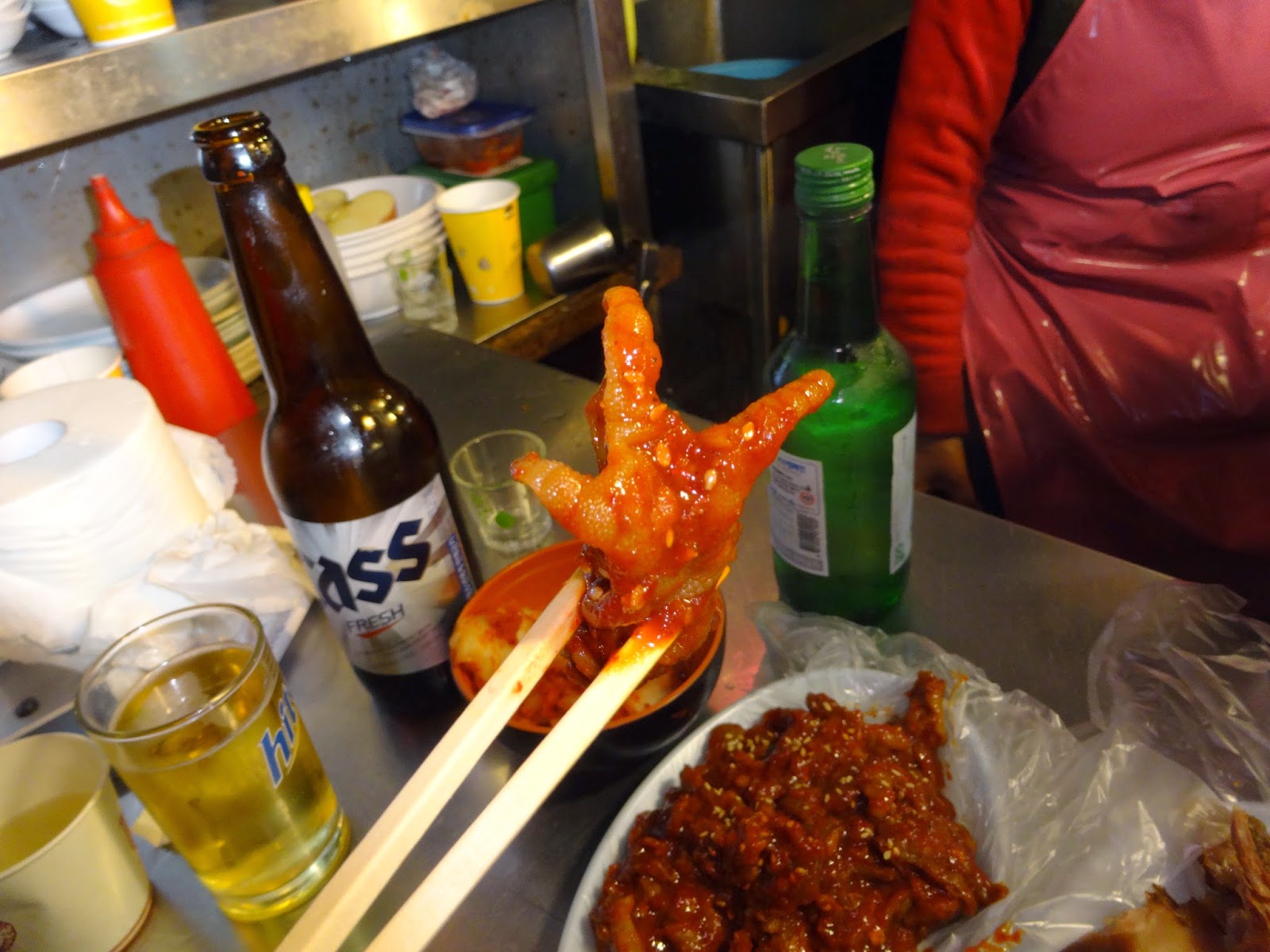
Some men like breast, others like legs, but the foot fetish
guys are always the weirdest – and the same applies for chicken. Dakbal, as it’s
known in Korea, is a dish of spicy chicken feet. The look and sound horrific
but in actuality they taste OK. The initial thought of popping one in your
mouth is the worst part, but my question is ‘why bother?’ When there are so
many better parts to eat; a succulent breast, a tender thigh, I was struggling
to think of a reason to eat chewy, meatless feet. It was an experience that I
shall not repeat.
The waste not, want not culture of Korean food doesn’t stop
with chicken feet, the Koreans also enjoy jokbal which is a dish consisting of
pig trotters cooked in soy sauce. I tried this dish in Gwangjang Market and it
left me unfulfilled. Friends had told me prior that it was delicious, a delight
not to be missed. Well, what I ate was disgusting. It was extremely tough to
chew, pretty much all skin, and served cold. I was told after that this is not how
it should have been served. So I’ve literally experienced the worst kind of
jokbal available.
Beondegi is a dish that I haven’t been brave enough to try.
The main reason being that beondegi is silkworms and they smell exactly as you’d
imagine a steamed bowl of silkworms would smell. Fucking rank. It’s another
case of ‘why?’ I’m sure that when food supplies were scarce you had to make do
with what food was available, but nowadays Korea has one of the strongest
economies in the world. Even Bear Grylls would turn his nose up at beondegi.
And, probably by far, the most commonly known food to come from Korea, is of course dog soup (bosintang). There is a lot of controversy regarding the consumption of dog meat, and many state that it is technically illegal to eat. So, for the record I definitely did not eat bosintang on the 23rd February around 4pm, but if a fictional person in Korea were to go to a restaurant and eat bosintang it might look like this (right). If one were to eat it, they might say that it tastes like low grade beef, and that it's as chewy as a piece of leather, and that it's likely that they'll pick it out of their teeth for a week. But, who actually knows? That's just the imaginary opinion of a fictitious person. I won't be rushing out to get another bowl anytime soon...I mean that person won't be rushing out. But, as the saying goes "it could be worse, you could be Scouse, eating rats in your council house". I'm just reporting on this, but leave me alone with your pet at your own risk.
Often in my classes my students are all too happy to tell me
that they once visited England and “experienced” British cuisine. They say it’s
salty and horrible. Food is subjective, and in my personal opinion I’d much
rather have a Sunday roast than bulgogi, and I’d share a bucket of
vindaloo with Fat Les rather than eat chicken feet, but each to their own.
The 13th of December marked a full year in the Republic of Korea for The Tefl-on Don, and as some of you may already know I have decided to extend my stay for another 2 months. So, I plan to be back in beaming Bedford sometime in March.
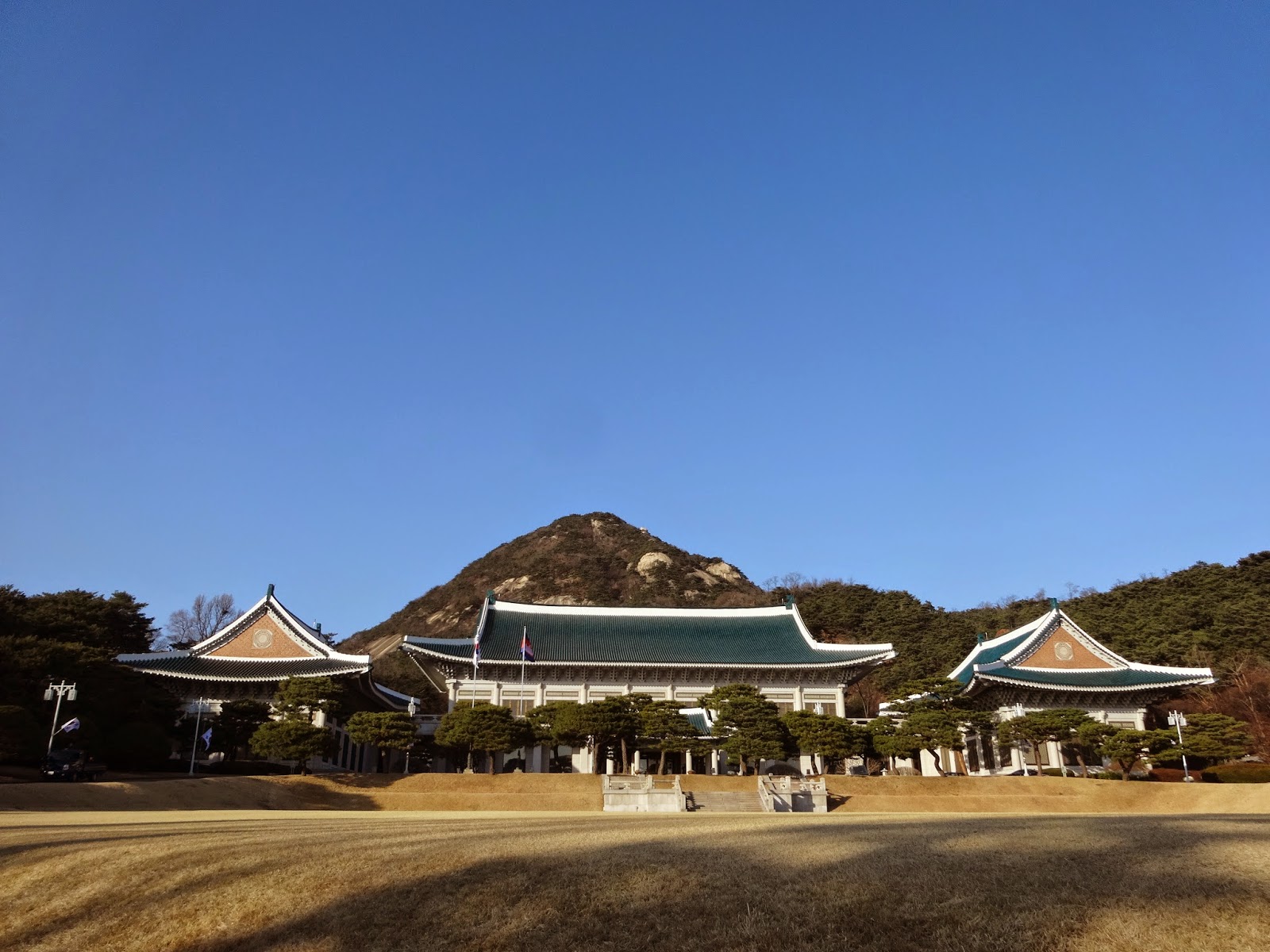
Last weekend we went to Cheong Wa Dae, also known as The
Blue House. Cheong Wa Dae is the office and residence of the Korean head of state.
We booked the tour three months in advance and I was truly looking forward to
it, to be inside such a significant building where the country is run would be
inspiring. In reality you don’t go inside the building, you hardly even get
close to it. Considering it is called the Cheong Wa Dae Tour it is very
disappointing and misleading, it should be called the Cheong Wa Dae Garden
Tour. Had I known this I would have been less interested, especially as it was
-5°C in the middle of December.
The sub-zero freezing tour went like this… “This is a
170-year-old tree”. Don’t care. “This is where the former presidential office
once stood”. Not concerned. “This is where foreign dignitaries stay when on
official duty in Korea”. I don’t have any flying fucks to give. It was far too
cold for sightseeing.
The following day we went to watch ROAD FC, or Korean UFC to
you and I. Now, this was interesting. Violence, ring girls, and sipping Poju
(Powerade and Soju) made for an excellent Sunday evening, and all the better as
we got free tickets (thanks Susie!).
This was my first experience of UFC. I rather enjoy boxing,
but this sport is different. It is so much more violent and seems to lack
concern for the fighters’ safety in my opinion. In boxing it seems that the
referee is willing to intervene quicker, preventing any unnecessary blows to
the head. Throughout the many fights we saw on Sunday evening the fighters were
allowed to knock a fighter to the floor (some seemed unconscious) and they are
allowed to continue punching them on the head until the ref stops the fight. I didn’t
like this aspect.
Fighters would enter the stage to their own choice of music,
most played high tempo rap or rock songs to build anticipation. But my
favourite fighter came out to Westlife’s version of You Raise Me Up. It was
hardly intimidating but he won.
The best part of the evening was the women. As if there wasn’t
enough testosterone in the bodies of every emasculated man in the audience, the
women caused quite a stir.
And speaking of women, allow me to introduce you to Song Ga-Yeon.
She is a ROAD FC fighter.
With her involved I would enjoy being her punching bag. The
beating that I’d taken would definitely be worth the semi-naked contact in an
enclosed ring.
The Korean Demilitarised Zone (DMZ) is known to be “the most
dangerous place on earth”. OK, that seems an exaggeration; I can’t help
but think central Africa, the Gaza Strip, or Middle Eastern war zones where
people are beheaded are slightly more dangerous. The DMZ is a place where any idiot with a camera, such as
I, can stroll around unharmed. Sure, some people have been shot here, but
that doesn’t make it the most dangerous. A more accurate description would be ‘the
most heavily guarded’. I’d rather take my chances here at the DMZ than on a
night out in Luton.
The tour starts at the DMZ Observatory Post, here you can look into North Korea. The main thing you can see is Kijong-dong, a village in the
North known as Peace Village, but outsiders know it as Propaganda Village. This
is a fake village where propaganda about the country’s great leader, and music
will play for 20 hours a day. It is all an act as no one lives in the village,
as you can see doors and windows painted on to the buildings. In the 1980s the
South Koreans erected a flagpole on their side of the border, only to be outdone by the North as they built
a taller one soon after.
The view of North Korea from the DMZ Observatory Post. It's difficult to tell from the picture but the trees stop suddenly on the North side of the border. This is to make it easier to spot any potential escapees to the South.
Propaganda Village, a fake village visible from the South.
The next stop on our tour was to look at the third infiltration
tunnel that was discovered by South Korean soldiers in 1978. The North used
dynamite to hollow out a tunnel, although they claim they were looking for coal…sure.
We entered the tunnel (not an innuendo), and it was, erm, a tunnel. Long, dark,
and narrow. Like most tunnels.
Soon after we went to Dorasan Station, a station that once connected
the two divided countries for all of… 1 year. As tensions grew once again they shut it down. The station was used to transport materials and goods to and
from Kaesong Industrial Region (a joint business venture by both countries, the
cheap labour of the North is utilised by major companies from the South).
Finally, we visited the Joint Security Area (JSA), an area
on the DMZ that is used to host negotiations between the two countries and the
United Nations. This room is on the border, quite literally half of the room in
the Republic of Korea (South) and the other half in the Democratic People’s
Republic of Korea (North). Prior to entering this room we were briefed on the
risks and we signed our lives away in expected fashion. We were under the
control of a 20-year-old American soldier, who openly said “I don’t care if I
cause open fire, but y’all might not like it” and “I don’t read books, I only
read magazines”, this was the guy in charge.
We stepped out onto the steps of Freedom House; we looked across
the JSA buildings, the North and South soldiers in stand-off, and Panmungak
(the main North Korean building). There was a huge amount of tension, none of
the tour group dared to speak; it was eerie, and dangerous. Apparently, when
out in the open where we were North Korean snipers are aiming directly at us,
anticipating any provocation.
We went into the JSA building where there were South Korean
soldiers on duty. They stood motionless wearing sunglasses (a scare tactic to
intimidate the Northern soldiers). They are all highly trained in Taekwondo,
and this was as close as I was willing to get to him.
The seemingly insignificant picture of the slabs on the
ground (above) do have significance. The concrete slabs represent the border
line between the countries, and standing to the left of the slabs shows that I
have crossed the border into North Korea. That’s something off the bucket list!
We were in the JSA room for 5-10 minutes before we were
ushered away.
The last stop before heading back to Seoul was at the Bridge
of No Return, a bridge used for prisoner exchanges after the cease-fire in
1953. Prisoners of war were allowed to choose whether to stay in the country of
their capture or cross the bridge to the other country, once a decision was made they could never
return, hence the really imaginative name.
The DMZ tour was very interesting; although very touristy
there are plenty of interesting sites of the formed of the divide. Whether you
know a lot about the Korean conflict or not I would still recommend it. If you
don’t know much about the North Koreans, allow me to summarise. North Korea
hate all Americans, with the exception of the eccentric, alcoholic, spouse beating, transvestite
that is Dennis Rodman. He’s the one they accept. If that doesn’t show how
fucked up their county is then nothing will.
Angie and I went away for the weekend to Gyeongju. Gyeongju
is known as the “museum without walls” and was the capital of the Silla dynasty
for almost 1,000 years (57 BC – 935 AD). During Korea's many conflicts with Japan
and the North a lot of their historical sites have been damaged or destroyed.
In some cases structures have been rebuilt, this reconstruction period took
place in the 70s and 80s, meaning that the authenticity is lost slightly. In
contrast, the many sites in Gyeongju were untouched during these battles – they’re the real McCoy. It was
to be a weekend retreat away from the smog and the bustle of city life in
Seoul.
Upon arrival we walked around the Daereungwon Tomb Complex,
it was the place where all the former kings of Silla were buried many years
ago. The complex has been well preserved, and with the foliage changing colour
it was an enjoyable wander. Having said that, it is essentially a glorified
graveyard. One of the tombs has been excavated, and is open to the public were
you will see historical artefacts, and the place where the king was laid to
rest. You're in and out of this public hole in about 10 minutes – a lot
like the girls on Geordie Shore.
Our walk soon took us to the Cheomseongdae Observatory.
Cheomseongdae means 'star-gazing tower' in Korean (according to Wikipedia). Built
in 7th century, it is the oldest observatory in East Asia. It is a
reflection of how developed the people of Silla were.
Our tour of Gyeongju continued to the Anapji Pond. An
artificial pond and garden built in the 7th century. We arrived just
before sunset, and it really was beautiful. The water was still and peaceful,
and as the sun went down and the lights came on you could see a perfect
reflection of the pavilion on the water. After the sun had descended the area
became manic, all the other tourists showed up in their thousands. The last
time so many people showed up to take pictures of a pool of water was when
Michael Barrymore last had a party.
With a day of sightseeing behind us we looked for a room for
the night. That night was to become my first experience of a Korean love motel.
These motels are very popular in Korea, young adults will continue to live at
home with their parents until they are married, this inevitably leaves little
time at home for private encounters. In Gyeongju, there seemed to be very few
places available so the motel had to suffice.
We paid for the room up front, a very modest
₩40,000 (£24), this included a “welcome package” which comprised condoms and
toothbrushes - preventing pregnancy and plaque are high on every love motels’
agenda. The stairway was dark, only lit by the light from the emergency exit
signs. The third floor was brighter than the others as it was lit by a ceiling
light which had a red light shade to reinforce the cliché. We walked past a
vending machine which had sold out of condoms. Classy.
The first impressions of our room were overwhelming; it was a
mixture of astonishment, dissatisfaction, and hesitancy. The décor looked
something out of Eastern Europe in the 1960s. It looked clean but felt dirty,
and seedy. Dirty like a Law and Order: SVU crime scene, and seedy like a job
interview with Peter Stringfellow. Luckily, I left my UV light at home. I had
heard a few rumours about love motels in Korea, one was of the free dirty porn
channels. I turned on the TV only to be disappointed - 3 channels and no porn.
Another rumour I had heard was that you can ask for a dirty movie at the front
desk, I suppose that’s what the VCR player was for, but I wasn’t brave enough
to ask. It was far from glamorous but it was a place for the night.
The next day we decided to first check out the World Culture
Expo Park, the main feature being Gyeongju Tower which has a nine-story pagoda
cut out in the middle, this is homage to the Hwangnyongsa Temple pagoda which
was destroyed by the Mongolians in 1238. It was the tallest structure in the
world at the time, reaching a height of 80m.
Soon after we made our way to Bulguksa Temple, the head
temple of Korean Buddhism, and is considered by many to be the best. The
initial building of the temple started in 528, it is vast and incredibly
impressive. But with this title it has become a bit of a tourist trap. There
were hundreds, if not thousands of people there, which killed the vibe. I’m no
Buddhist monk but I was under the impression that the temples are meant to be
peaceful, tranquil places for prayer and meditation, instead Bulguksa is filled
with crowds, crying children, slow walking tour groups, tour group leaders with
PA systems, and constant queues because some twat is taking another selfie. It
says it all that the temple has a souvenir shop. I’m not saying don’t go to
Bulguksa, but I would encourage you not to go on a weekend. If Buddist temples
are your thing then go to a smaller, less popular one. There you will get a
true, authentic experience, you will get the place to yourself, and you’ll see
monks in their daily routine. You will not see this at Bulguksa.
Sunday was wrapped up with a short visit to Seokguram
Grotto, 4 miles up the mountain from Bulguksa. A giant stone Buddha has been carved from a
single rock. An impressive feat but it wasn’t something I could truly admire as
a non-Buddhist. I could only appreciate it for its artistic value, which took
all of about 2 minutes. If you’ve seen a Buddha statue before then don’t bother
going to Seokguram Grotto. There I just save you a trip.
It would have been nice to stay another day, there were some
other places I wanted to see but after a while it started to feel very similar.
Temple, field, shrine, pavilion. Temple, field, shrine, pavilion. Returning to
Seoul where there is civilisation, where restaurants aren’t empty after 9:30pm,
and you don’t have to wait 20 minutes to get a taxi was nice. Gyeongju is a
nice escape, but I am thoroughly glad to be living in a city.
Karl and I recently travelled to Japan over the Chuseok
break. Japan has always been a country that I have wanted to visit, arriving
there I felt an excitement that I haven’t felt in other counties. Being in
Japan for the first time it reminded me of the time that I arrived in Korea. I
was in an unfamiliar Asian country where language was an issue (for me, not the
locals… they can speak Japanese pretty well). In Korea I’ve picked up enough of
the language to get by, but in Japan I was back to hand gestures and pointing.
While I was struggling it didn’t take Karl long to start mixing with the
locals.
Our first evening in Tokyo, Karl and I decided to explore
the local region around our hotel. Before long we noticed that we were in the
red light district of Tokyo, that’s why the hotel was so cheap. (The area is
called Shinjuku if you’re planning on going). As we wandered around we were
constantly approached by Nigerian men who try to lure you into the “bars” and
“clubs”. When they approach you they say things like “you like girls?” or
“Japanese girls sex” or “FREE TITTIES!” As much as I like girls, sex, and free
titties, I was not in the market for those services on that particular night.
Unsurprisingly, these guys started to get very annoying. When you turn down
their offers they try to entice a response from you by saying “you don’t like
titties?!” Karl and I started telling them that we were in Tokyo on our honeymoon,
that kept the guys at bay. If there’s anything that will ward off Nigerians it
is homosexuality. Karl and I just started making out in front of them just to
prove a point.
This is all the touristy stuff we did:
The following morning. When looking for things to do in
Tokyo, Karl told me that we should “have a beer for breakfast”. I’m not sure
how that is unique to Tokyo but we obliged, and in true British fashion we had
a beer and a curry for breakfast.
We went to the Meiji Shrine. It was vast and very Asian. It
was a cool thing to see but having seen a lot of cool Asian things in Korea I
think the novelty has worn off a little. It’s like when Lindsey Lohan did her
first line of coke, I bet she got a huge thrill out of it but now when she
vacuums up a line it’s a little underwhelming. That’s like me with Asian
monuments.
A little later we went to the Shibuya Crossing, you often
see it on TV. It’s a huge crossroad where all 4 directions of traffic stop to
let hundreds of people cross the street. It doesn’t sound that cool when you
write it down but it’s a touristy thing to do. Shut up.
A trip to Japan wouldn’t be complete without seeing some
robots and the place to see them is at The National Museum of Emerging Science
and Innovation. You should have seen Karl’s face when we were there, it’s
basically Disneyland for him. His smile got wider when he saw the exhibits and
he started learning. I asked Karl shall we do some more sightseeing? He
scoffed. I asked him, shall we get something to eat? He said “why?” I asked
him, shall we go to a bar and meet some ladies? He said “science is the only
sexual stimulus I need”. They are genuine quotes. We hung around for the Honda
Asimo exhibit, which was pretty cool.
A Japanese phenomenon that I was unaware of was the maid
cafes. Essentially, these are cafes where cute Japanese girls dress up as
French maids and serve you, these exist for lonely guys who want cute girls to
pay them some attention. Like the lonely tourists we were we went. We ordered
some food and drinks and then the girls made us repeat the phrase “delicious
magic, meow, meow, meow!” It was so cringey. It was also the most ridiculous
thing I’ve heard since Harry Redknapp said that Tottenham could win the league.
There were 3 groups of people at this particular café; some drunk businessmen,
a loner (who was there on his birthday!), and the foreigners. I don’t want to
sound elitist but the other guys were fucking weird. We joined in with the
silliness of the experience because it was funny but the other guys enjoyed it.
The lonely guy who was there alone for his birthday requested that everyone
should sing happy birthday for him. When he counted down 3, 2, 1… Karl and I
were the only ones who sang. I felt sorry for him, having no mates, going to a
maid café for your birthday alone, and the only people singing happy birthday
are two random foreigners who don’t know your name. “Happy birthday dear… Happy
birthday to you!” Poor bugger.
Whilst in
Tokyo I noticed that there are a lot of white people. In Korea, there are a lot
but usually only in the “white people areas” of Itaewon and Hongdae. In Tokyo
they’re everywhere. The white people in Korea seem normal, they’re most likely
teachers, or in the military. But the white people in Japan are just strange,
they’re the weird kids at school who were into anime and Dungeons and Dragons,
and there are thousands of them.
We went
back to Shinjuku (the red light district), mainly because our hotel was there.
The sex trade is almost non-existent in Korea, so I’ve heard. But in Tokyo it’s
in abundance. Anything you want is on offer, and it wouldn’t take long to find
whatever you’re into. A crazy thing I’d heard about Japan that I wanted to
investigate was used panty vending machines. Not that I’m into that kind of
thing… honest. But, I’d heard that this craziness existed and I wanted to see
it (the vending machine, not the panties). I must have looked at every vending
machine in the area but I couldn’t find a panty pantry. I was quite
disappointed. I’ve since read that they don’t exist anymore but were available
about a decade ago.
One thing that the Japanese do well is British pubs. They have dozens of
them. I know, I know, you go all the way to Japan and you spend your time in a
British pub, it’s madness but sometimes you just want a quick pint. We made up
for it by trying the local cuisine. Karl and I both sunk our teeth into a
chicken Teriyaki sandwich from Subway. We were fully immersed in Japanese
culture.
The craziest thing we did in Tokyo was the Robot Cabaret Show. It seemed
a little expensive at ¥6,000 (£40) a ticket but I can say it’s worth every yen.
It’s not a show that you will fully understand unless you witness it for
yourself. The best way to describe the show is that someone took a lorry load
of acid and filmed what they saw. I went to Japan looking for weird shit and I
found it. If you go this is what to expect; dragons, robot eating sharks,
masked men shredding it on guitar, tanks and Gatling guns, giant snakes, robots
fighting pandas, robots fighting tribesmen, Japanese women in bikinis riding
10ft robotic women, and so many other things that my brain couldn’t process at
the time. It’s been a week and I’m still trying to comprehend what I witnessed.
(See the video below for some highlights).
The video highlights:
Japan is
probably the most interesting country I’ve been to, they can boast history,
scenery, bustling cities, and pure crazy. But I don’t think I’d like to live
there. The weirdness would become the norm and then the rest of the world would
just be a disappointment. It’s OK that Japan is strange because you can
experience it for a week and then go home. I was a tourist to the craziness,
but the people that live there are prisoners to it.


 One of the more normal dishes I tried at Gwangjang was
yukhoe. Yukhoe is seasoned raw ground beef topped with a raw egg, or as it’s
more commonly known in other countries as ‘E.coli topped with salmonella’. The
taste was uninspiring, I tried to explain to the waiter that both ingredients
tasted better when cooked, but there must have been a language barrier. I read
after I had eaten it that in 2011, 5 Japanese people died and 35 were hospitalised after
eating yukhoe. Jamie Oliver can say what he likes about the standard of school
dinners in the UK, but 10 years of eating Turkey Twizzlers probably saved my
life. My stomach could probably fight off a pint of bleach without much hassle.
One of the more normal dishes I tried at Gwangjang was
yukhoe. Yukhoe is seasoned raw ground beef topped with a raw egg, or as it’s
more commonly known in other countries as ‘E.coli topped with salmonella’. The
taste was uninspiring, I tried to explain to the waiter that both ingredients
tasted better when cooked, but there must have been a language barrier. I read
after I had eaten it that in 2011, 5 Japanese people died and 35 were hospitalised after
eating yukhoe. Jamie Oliver can say what he likes about the standard of school
dinners in the UK, but 10 years of eating Turkey Twizzlers probably saved my
life. My stomach could probably fight off a pint of bleach without much hassle.
 The waste not, want not culture of Korean food doesn’t stop
with chicken feet, the Koreans also enjoy jokbal which is a dish consisting of
pig trotters cooked in soy sauce. I tried this dish in Gwangjang Market and it
left me unfulfilled. Friends had told me prior that it was delicious, a delight
not to be missed. Well, what I ate was disgusting. It was extremely tough to
chew, pretty much all skin, and served cold. I was told after that this is not how
it should have been served. So I’ve literally experienced the worst kind of
jokbal available.
The waste not, want not culture of Korean food doesn’t stop
with chicken feet, the Koreans also enjoy jokbal which is a dish consisting of
pig trotters cooked in soy sauce. I tried this dish in Gwangjang Market and it
left me unfulfilled. Friends had told me prior that it was delicious, a delight
not to be missed. Well, what I ate was disgusting. It was extremely tough to
chew, pretty much all skin, and served cold. I was told after that this is not how
it should have been served. So I’ve literally experienced the worst kind of
jokbal available. 
 And, probably by far, the most commonly known food to come from Korea, is of course dog soup (bosintang). There is a lot of controversy regarding the consumption of dog meat, and many state that it is technically illegal to eat. So, for the record I definitely did not eat bosintang on the 23rd February around 4pm, but if a fictional person in Korea were to go to a restaurant and eat bosintang it might look like this (right).