It's a country that has always intrigued me. A hermit nation that doesn't abide by democratic ideologies nor UN sanctions. A lot has been documented and speculated about this secretive country, but little has been confirmed due to the inaccessibility.
A nation set up alongside the Soviets and supported by China is now one of only five remaining communist countries. Many books and documentaries consumed and having lived on the south side of the border for a few years, I just had to see it for myself.

Was it the best-timed trip? Well, not really with what happened with Otto Warmbier and the threats from the Rocket Men. But is there ever a good time to visit North Korea?
In the weeks leading up to our departure I was slightly concerned, every morning I'd flick through the headlines on BBC News with most of them focused on a back-and-forth between Trump and Kim. Those headlines didn't bother me so much, they've been going on for weeks and little has materialised other than an international competition of "my penis is bigger than yours". And, let's be frank, it's a competition neither of them would win comfortably.
The stories ranged from threats on Guam, missile tests over Japan and Trump weighing in with some inane fighting talk. The US military was "locked and loaded" and that the US would "totally destroy North Korea" if necessary. Kim Jong Un went on to describe Trump as "mentally deranged". Imagine that, Kim Jong Un calling you mentally deranged. You seriously need to have a look at yourself in the mirror if that's happening. We're lucky to have two rational, level-headed leaders in charge of those big red buttons.
A moral question I was repeatedly asked was: aren't you concerned about funding the regime? Of course, it's a concern, but one may argue that everyone's tourist spending in America contributes to them funding the bombing of thousands of innocent people in Syria. Consider that next time you're in soaking up the sun in LA.
I was joined on this suicidal journey by Karl. Karl still lives in Seoul, a mere 195km from Pyongyang, but had to access the capital by flying to Beijing, then flying on to Dandong before getting an extremely slow train that was pulled by peasants (well, it certainly felt that slow) from the border to the capital, Pyongyang. It took Karl numerous hours of travelling to get there, I'm pretty sure Eddie Izzard could have run the 195km from capital to capital in a shorter time.
Karl and I arrived in Dandong on the Chinese-North Korean border and we were about 80% excited and 20% terrified for what lay ahead of us in the following 3 days.
 |
| Our last picture in the free world #Mao |
Up early as we were meeting the tour group outside Dandong train station at 8am sharp. We hovered around the entrance without much sign of the tour leader. A group of people started to form and we speculated that they might be our travel companions. It was a good bet considering they were the only whities in a mass of Chinese people. A giant Australian, named Rowan, later arrived and introduced himself as our tour guide. His height made me uneasy. I nestled in among the Chinese lads to boost my self-confidence.
Everyone was accounted for, we were all issued our visas and we made our way through international departure. At the first security check-point, Rowan was acting like a tit. He was very handsy with the police officer who was checking our visas. He was hitting his hat, nudging him, pinching his arse. I thought “this is the guy overseeing our safety in North Korea? This guy isn’t going to make it out of the train station!” Luckily he made it through and made it onto the train headed for Pyongyang. First stop Sinuiju.
Sinuiju is the first town on the other side of the Chinese-North Korean border, 940m across the Sino-Friendship Bridge. This is where the very stringent security check would take place. It was quite honestly, one of the most daunting experiences of my life. The North Koreans bordered the train and immediately took our passports. We were at their disposal. They conducted a baggage search. Censorship is quite the pastime in North Korea, with religious documents, certain publications, and pornography all banned. Luckily they didn’t find the Playboy in my hand luggage and the butt-plug up my arse.
Reliable Rowan was on hand to get us out of this sticky situation. He slyly handed (in plain sight to everyone) the security officers a packet of American cigarettes to each of them and they were happy to let us through. We had time to kill while the rest of the train was searched so we were ordered off the train to stock up on supplies for the 6-hour journey to the capital.
Karl and I had reminders of “funding the regime” ringing in our heads but made an enquiry to alcohol.
“How much alcohol do you have left?” We politely asked the refreshment ladies.
“There are only 8 large bottles of beer and 2 bottles of soju left.”
“OK, we’ll take the lot.”
We had been off the train for a mere 30 seconds and were less than a kilometre into North Korea before we had lost our morals. Don’t judge us, 6 hours is a long time to spend on a train.


Tensions had eased and we were enjoying ourselves. What was all the fuss about?!
We drank all the way to Pyongyang, marvelling at the sights of rural North Korea. It was fascinating. The towns were tiny and there were no cars. People got around on foot or bicycle if they were lucky to have one. The people were dirty and had clothes that looked like they were donated by the USSR in the 60s. Propaganda messages were placed high in the hills as people hand-worked the fields below, with cattle mainly used for pulling carts between towns. It felt like we had gone back in time or at least to the opening scenes of Borat.


We arrived in Pyongyang a little tipsier than anticipated and Karl and I rushed to take pictures.

When we went to re-join the group on the platform they had gone. We had been in Pyongyang for all of 3 minutes and had managed to lose the group.

When we went to re-join the group on the platform they had gone. We had been in Pyongyang for all of 3 minutes and had managed to lose the group.
Some North Korean ladies started speaking to us in English and we had to introduce ourselves as the mongs that got lost instantaneously.
Our first evening there was spent by strolling through the streets of the city. It was all very normal. People were heading home from a long day at work, others were drinking in pubs. We stopped at Kim Il-Sung Square (the square you see on the news with the military parades) where it was all kicking off. There were thousands of people there who were rehearsing a big song and dance for the anniversary of the founding of Kim Il-Sung’s Worker’s Party of North Korea on the 10th of October.
We finished the evening in the hotel bar discussing what we’d seen today with the rest of the tour group. It was all smiles until Mr. Kim arrived. He was the muscle and was seemingly there to keep tabs on what our tour guides said to us. His presence at the bar was met with silence. He joined our conversation and was, in fact, very welcoming. A few beers in and we were chatting away and he gave us the freedom to ask any questions we liked. It seemed like a trap, but after a few more beers, we were listening to his theories on America, Trump, South Korea, China, and, of course, North Korea’s majesticness.
I sat and listened to him pensively as it’s not every day that you get a chance to speak openly with a North Korean. I wish I could have recorded all of it, but just had to rely on my drunken memory which is unreliable at the best of times.
Here is a little wisdom he shared with us...
Here is a little wisdom he shared with us...
It’s rude to refer to North Korea as North Korea and it’s actually referred to as the DPRK. There is a correct way to fold a newspaper and that’s to make sure you don’t fold the pictures of the great leaders. He thought China are selfish neighbours. He held little resentment towards the American people, but a lot towards their government. The Great Wall of China was in fact erected to protect China from the Koreans, not the Mongolians. As well as so much more that was just impossible to remember.
We retired to our very nice hotel room which just so happened to be bugged with hidden microphones.
Day 2 in the DPRK:
I woke up with the shits. We headed down for breakfast only to realise that we were late. Did you know the DPRK has its own time zone? Nor did Karl and I. They are +7:30hours ahead of GMT. It was not an ideal start to the day.
On the bus and we were off sightseeing with an air of confidence, much like the time Kim Jong-Il bowled a perfect 300-game or when he sank 11 holes-in-one the first time he played golf. I actually would have been happy enough not to have shat myself that day.
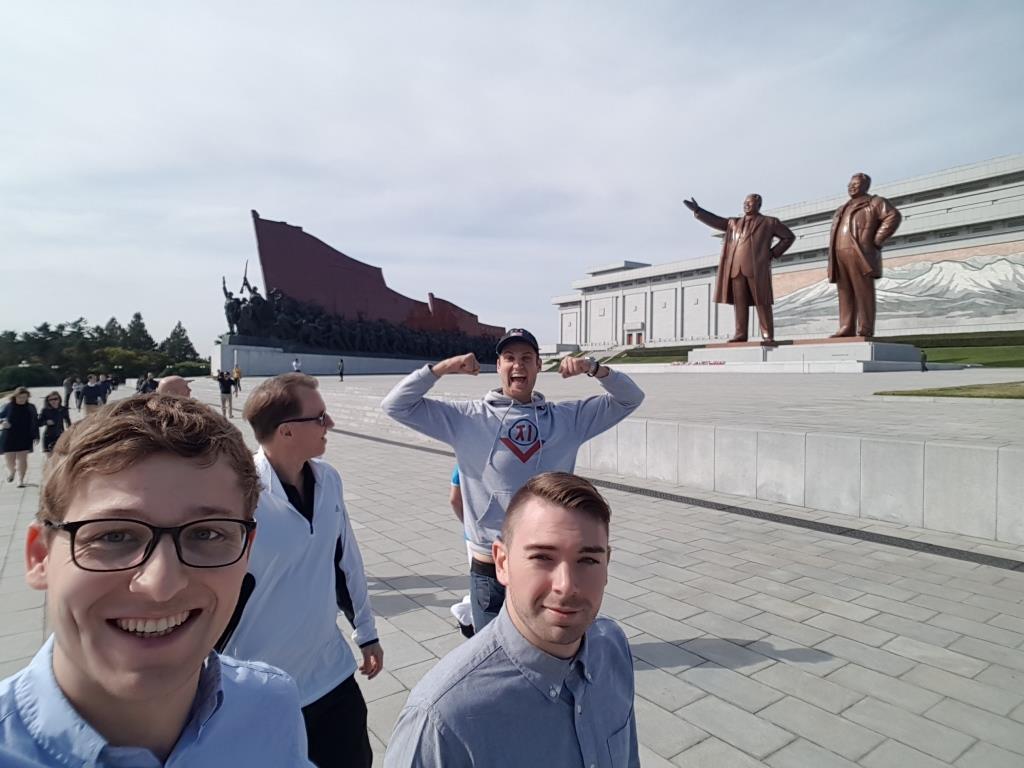
Before long we were off to lay some flowers at the bronze monuments of the Great Leaders Kim Il-Sung and Kim Jong-Il. We approached the statues with strict orders to pay our utmost respect to them. I walked up to the base, placed the flowers, walked 20 metres back and bowed the best bow I could. It was at that moment I thought “how has my life come to this?” Most people my age are holidaying in Malaga or taking their girlfriends off to Paris. I’m in the heart of Pyongyang bowing to 25-metre tall statues of dead communist leaders.


Next stop on our tour took us to the Juche Tower. Juche was a theory of self-reliance which cut the country off from the rest of the world. I thought it was best to keep the reminders to myself about financial and oil-aid from China and food-aid from America and South Korea. I guess that’s why Juche is just a theory.


Our next sightseeing destination was at the Monument to Party Founding. This monument is a classic communist sight, a hammer, a sickle but with an added calligraphy brush which represent the workers, farmers, and intellectuals. The DPRK pride themselves on having a depiction of education, but not too much education, because that never really works out for communism.


We took a ride on the subway (seriously, who does that for fun?) It was quite interesting to see the locals up close. They didn’t seem too fazed with 15 foreigners in the carriage with them. Maybe they’ve seen it all before, or maybe they’re taught not to acknowledge us? Who knows?
At one point the carriage got very tight and one unsavoury person pushed everyone very hard resulting in me squashing an old lady. I apologised to her in Korean, and she turned away immediately. Every now and then she’d give me a look over her shoulder. When it came to my stop I said goodbye to her in Korean and I got a smile that time. It was quite nice to have a pleasant moment with a local.

We disembarked the subway and took a stroll through a local park watched as families played. It was here that I felt I could have been anywhere else in the world (other than Beijing due to the blue skies).
At one point the carriage got very tight and one unsavoury person pushed everyone very hard resulting in me squashing an old lady. I apologised to her in Korean, and she turned away immediately. Every now and then she’d give me a look over her shoulder. When it came to my stop I said goodbye to her in Korean and I got a smile that time. It was quite nice to have a pleasant moment with a local.

 |
| Those two lads are quite literally everywhere. I expected the locals to stare at us a lot more than they did. I actually think I stared at them more. |
We headed back to the hotel and resumed the beer drinking from the night before. I made it through the day without shitting myself.
 |
| The propaganda is plastered around the city. |
 |
| Some waitresses from one of the restaurants. They wanted a picture with us as much as we did with them. The North Koreans seemed emotionless, they never smiled for pictures. |
Day 3 in DPRK:
Our last day in the glorious nation and we only had one place to visit, The Victorious Fatherland Liberation War Museum. We had a smoking hot tour guide give us the express tour of the museum. We were sat down and made to watch a documentary about who started the Korean War. You’re not going to believe the outcome, but it was the bloody Americans that started it all! Who’d have thought?


We had the long slog of a journey back to China ahead, but it was much more relaxed than on the way there. I was so at ease by the end of the trip. At the final security check, I was slightly tipsy, swigging on soju, flicking through a porno and quoting the Quran.
The whole trip was a jolly. We went, we had a laugh, mucked around, took pictures with the local girls, bought some propaganda material and went home.
There were times when I thought I could have been in South Korea or quite literally anywhere in the world. We visited a microbrewery, we sat drinking locally brewed beer talking rubbish. We played pool at the hotel bar and I was seeing 12 pockets instead of 6. We took a stroll in the park and saw families enjoying picnics and playing badminton. All very mundane pastimes that don't reflect the image that is portrayed on TV or the internet. The troubles you see in the media don't stem from the every day Joes, it's the egomaniacs in office.
The people we encountered were very accommodating and friendly and I can't speak highly enough of the staff at Young Pioneer Tours. We got answers to questions most aren't able to ask and it would appear that the people there truly believe what they are preaching. One person asked a tour guide if the images we saw of when Kim Jong-Il died were accurate, she went on to explain her love for the Great Military Leader and the party shedding a tear as she did so. It made me awfully sad to see someone react so emotionally about something that is based on lies. I suppose us outsiders will never know and experience the real DPRK, but getting this close is as good as it gets.
A big shout-out goes to my dear Eunju as she translated a lot of things for me. I went away on holiday and took loads of pictures and she got homework.
The people we encountered were very accommodating and friendly and I can't speak highly enough of the staff at Young Pioneer Tours. We got answers to questions most aren't able to ask and it would appear that the people there truly believe what they are preaching. One person asked a tour guide if the images we saw of when Kim Jong-Il died were accurate, she went on to explain her love for the Great Military Leader and the party shedding a tear as she did so. It made me awfully sad to see someone react so emotionally about something that is based on lies. I suppose us outsiders will never know and experience the real DPRK, but getting this close is as good as it gets.
A big shout-out goes to my dear Eunju as she translated a lot of things for me. I went away on holiday and took loads of pictures and she got homework.